
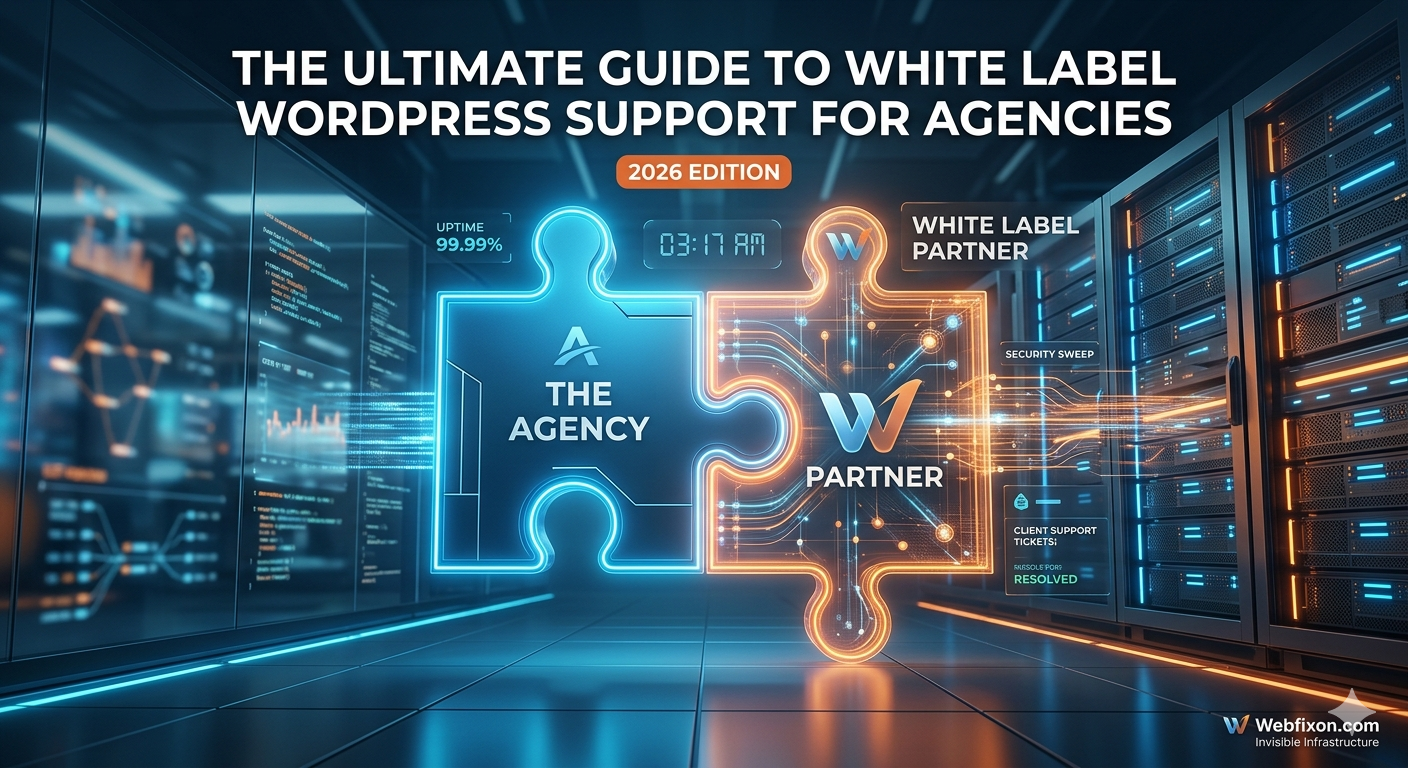
In the rapidly evolving digital landscape of 2026, the traditional agency model is facing a “scaling wall.” As an agency owner, you have likely experienced it: you successfully land high-ticket clients, your portfolio grows, but suddenly your team is drowning in maintenance tickets, plugin conflicts, and emergency malware removals. You are so busy “fixing” the past that you have no time to “build” the future.
This is where the concept of White Label WordPress Support becomes the ultimate competitive advantage. In this comprehensive guide, we will explore how a “silent partner” allows you to scale your agency without the overhead of a massive in-house dev team, ensuring your clients receive elite-level care under your brand name.
1. What is White Label WordPress Support?
At its core, White Label (WL) support is a partnership where a specialized technical team—like Webfixon—performs all the “heavy lifting” for your clients’ websites, but all communication and credits remain with you.
When a client submits a ticket for a broken checkout page or a slow-loading hero section, we fix it behind the scenes. You deliver the solution to the client under your agency’s banner. They see a fast, responsive, and reliable partner (you), while we provide the technical muscle that makes it possible.
2. Why 2026 is the Year of the “Lean Agency”
The days of hiring ten junior developers to sit in a physical office are fading. In 2026, the most profitable agencies are “Lean Agencies.” They focus on strategy, sales, and high-level creative work while outsourcing technical execution to specialized experts.
-
The Cost of In-House Devs: Between salaries, health insurance, and training, a single senior developer can cost an agency upwards of $100k+ per year.
-
The Webfixon ROI: With a white-label partner, you get 10+ years of “Top Rated Plus” expertise for a fraction of that cost. You only pay for what you need, turning a fixed overhead cost into a scalable variable expense.
3. Support vs. Maintenance: Why You Need Both
Many agencies confuse these two, but to rank as a top-tier provider, you must offer both:
-
Proactive Maintenance: This is the “preventative medicine.” It includes daily backups, WordPress core/plugin updates, security hardening, and uptime monitoring. It keeps the site from breaking.
-
Reactive Technical Support: This is the “emergency room.” When a client accidentally breaks a layout with Elementor, or a payment gateway stops processing, they need a human expert to jump in immediately.
A true white-label partner doesn’t just watch the site; they solve the problems as they arise.
4. 5 Strategic Benefits of a White Label Partnership
I. Infinite Scalability
Imagine landing a contract for 20 new WooCommerce stores tomorrow. Would your current team panic? With a WL partner, you simply add those sites to your dashboard. Your capacity becomes infinite because your partner scales with you.
II. 24/7 Peace of Mind
Website emergencies don’t happen during business hours. They happen at 3:00 AM on a Sunday. A white-label service ensures that while you are sleeping, your clients’ sites are being monitored and protected.
III. Brand Reputation Protection
Nothing kills client trust faster than a “Critical Error” message that stays up for six hours. By having a dedicated support team, you ensure that “downtime” is a word your clients never have to use.
IV. Specialized Expertise on Demand
WordPress in 2026 is complex. From Full Site Editing (FSE) to headless WP configurations and API integrations, one person can’t know it all. A white-label team brings a collective knowledge base that covers every niche.
V. Increased Profit Margins (MRR)
By reselling maintenance plans to your clients at a markup, you create a stream of Monthly Recurring Revenue. If you pay $29/mo for a white-label plan and charge your client $99/mo, you are generating a 240% profit margin on a service you don’t even have to perform yourself.
5. The “Invisible” Workflow: How It Works
Transparency with you, invisibility to them. Here is the typical Webfixon workflow:
-
The Request: Your client emails your support desk about a bug.
-
The Forward: You (or your automated system) forward the details to us.
-
The Resolution: We log into the site, fix the issue on a staging environment, and push it to live.
-
The Report: We send you a brief summary of the fix.
-
The Delivery: You notify the client: “All fixed! Our team has resolved the issue.”
6. Choosing Your Partner: Boutique Expert vs. Large Agency “Factory”
There are massive “white label houses” like E2M that handle thousands of sites. While they have size, they often lack the personal touch.
-
The “Factory” Model: You are just a ticket number. Your sites are often handled by junior developers following a script.
-
The “Boutique” Model (Webfixon): You have direct access to a Senior Web Architect. We understand your specific agency’s “voice” and the technical nuances of your specific builds. We act as a true extension of your team, not just a service provider.
7. Overcoming the “Fear of Outsourcing”
The biggest hesitation agencies have is: “What if they steal my client?” In 2026, professional white-label partners operate under strict Non-Solicitation and NDA (Non-Disclosure Agreements). At Webfixon, our business model relies entirely on agency success. We have zero interest in your clients; our only goal is to make you look like a hero so you keep sending us work.
Conclusion: Stop Debugging, Start Growing
The role of an agency owner is to lead, to innovate, and to grow. Every hour you spend trying to figure out why a CSS grid is overlapping or why a plugin update broke a site is an hour you aren’t spending on high-level strategy.
White Label WordPress Support isn’t just a technical service—it’s a business growth engine. It frees your time, protects your brand, and dramatically increases your profitability.
Ready to see how Webfixon can become your agency’s secret weapon? [Check out our White Label Plans] or [Schedule a Discovery Call] today.
Add a Comment